Forschung
Publikationen und aktuelle Projekte
Veranstaltung
Berlin, Februar 2026
1. Vernetzungstreffen
"Marx und Kritische Theorie in der Medienwissenschaft"
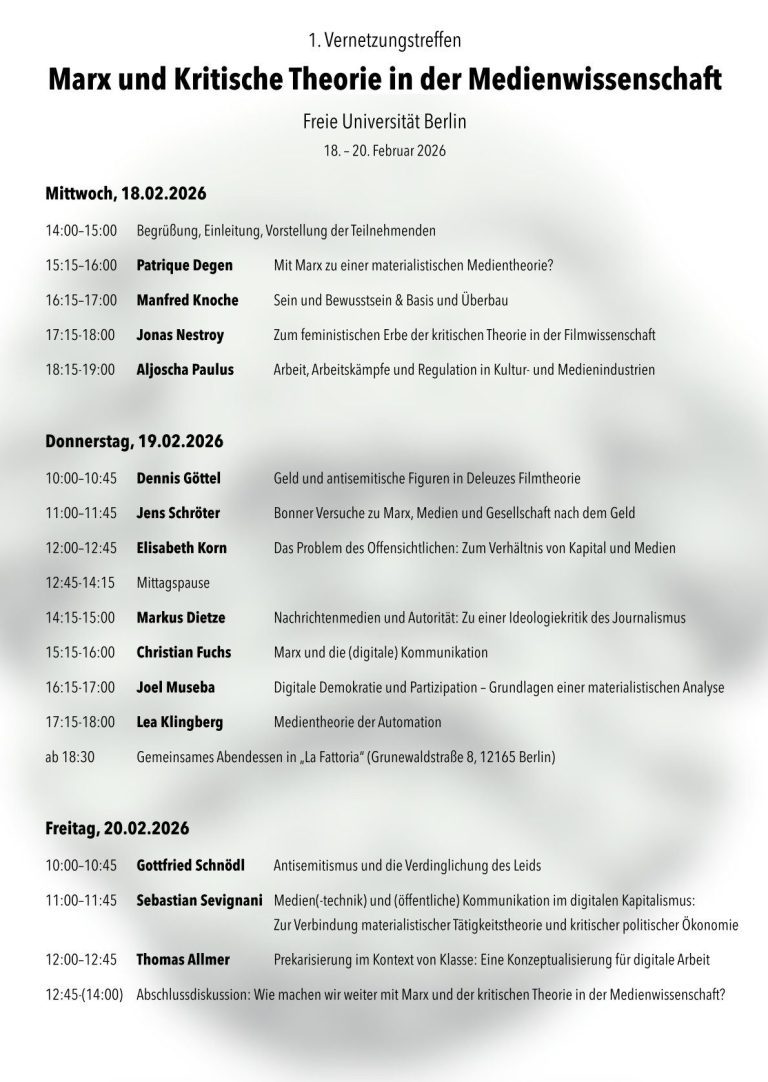
Im Februar 2026 versammelten sich am Seminar für Filmwissenschaft an der Freien Universität Berlin Forscher*innen des deutschsprachigen Raums, um sich über Themen, Methoden, Chancen und Probleme auszutauschen, die sich aus dem Zusammendenken von Medien mit Texten aus der kritischen Theorie sowie aus der Marxschen und marxistischen Tradition ergeben. Das Treffen wurde von Patrique Degen, Markus Dietze und Elisabeth Korn organisiert.
Filmprojekt
Zusammen mit Felix Klee
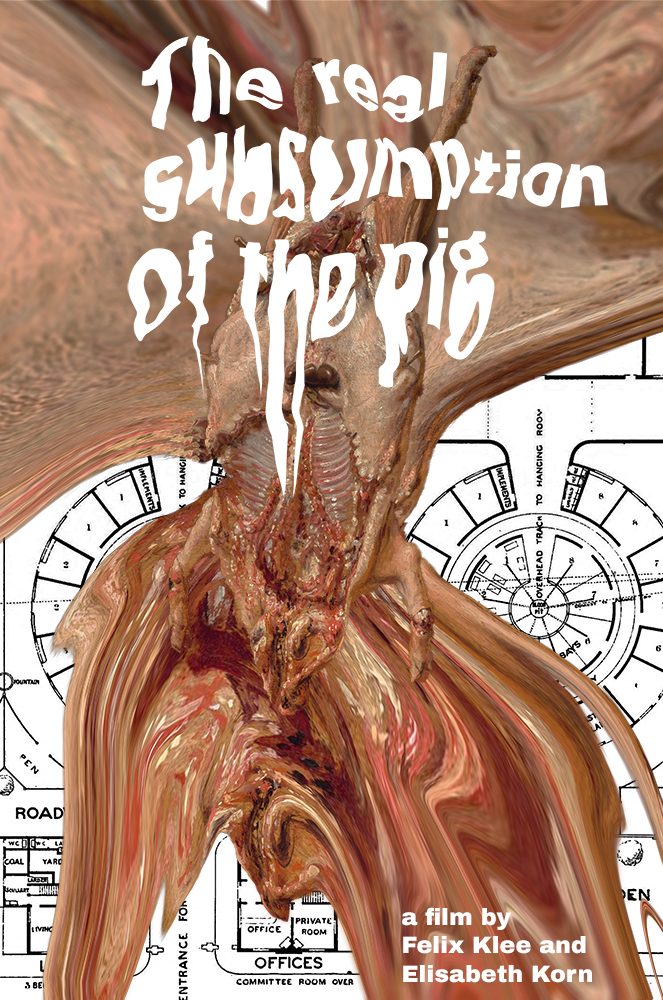
Die reelle Subsumtion des Schweins
The pig was subsumed under capital. This subsumption was expressed in round meat plants, evolving killing machines and refrigerated assembly lines. But under capitalism the pig itself was also changed.
"The real subsumption of the pig" is an essay film piecing together the changing pig's body and its surroundings shaped by capitalism using found footage.
Essay film
in production (rough-cut stage)
ca. 18 minutes
Written and directed by Felix Klee and Elisabeth Korn
Edited by Felix Klee
Publikation
Peer-reviewed
"An Image of Death, an Image of Life, and Nothing In Between"
This article juxtaposes two seminal texts on the ontology of the image published in post-war France: Maurice Blanchot’s ‘Les Deux Versions de l’imaginaire’ (1951) and André Bazin’s ‘Ontologie de l’image photographique’ (1945). Although these essays evince an astonishing similarity — both aim to answer related questions, namely ‘What is the image?’ and ‘What is the film image?’, both draw upon Jean-Paul Sartre and André Malraux, and both identify the image’s being with the power of death —, they arrive at fundamentally different and even opposed conclusions. By negotiating their similarities and differences, this article explores how Blanchot’s approach may be read as a helpful complication of Bazin’s exultant celebration of photography and the film image and, conversely, how Bazin may provide a key for understanding the fundamental antagonism of Blanchot’s bipartite image.
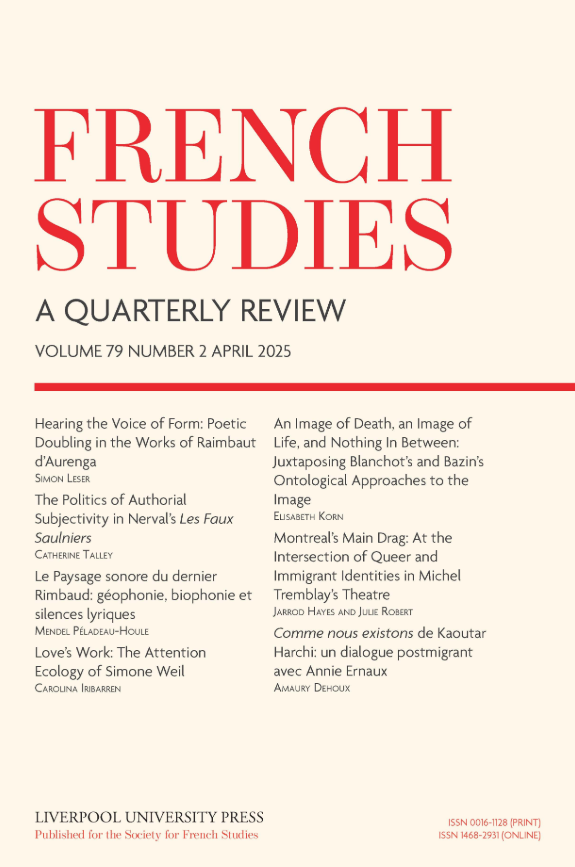
Elisabeth Korn, "An Image of Death, an Image of Life and Nothing In Between: Juxtaposing Blanchot's and Bazin's Ontological Approaches to the Image," French Studies, Jg. 79, H. 2 (2025): S. 231-244.
Publikation
Peer-reviewed
"Medientheorie und Politische Ordnung"
Dieser Beitrag schlägt eine Differenzierung zwischen Medientheorien des 20. und 21. Jahrhunderts hinsichtlich ihres Verhältnisses zu politischer Ordnung vor. Erstere verhandeln Medien als Mittel, die sich von einer politischen Ökonomie instrumentalisieren lassen. Letztere reflektieren hingegen eine zunehmende Fraternisierung von Medien, Staat und Kapital, die eine mediale Instrumentalisierung des Politischen nahelegt. Anstatt die Logik einer politischen Ordnung einzig zu reproduzieren, scheinen sich gerade Informations- und Kommunikationstechnologien (IKT) die konstitutiven Subjektivierungspraktiken, Handlungsschemata und Potenzialabwägungen politischer Institutionen einzuverleiben.

Elisabeth Korn, "Medientheorie und Politische Ordnung," in Christoph Ernst, Katerina Krtilova, Jens Schröter und Andreas Sudmann (Hrsg.): Handbuch Medientheorien im 21. Jahrhundert. Wiesbaden: Springer VS, 2024.
Publikation
Open access
"Paths Not Taken, Dreams Not Dreamt: A Rejoinder to Christian Fuchs on Democracy, the Internet, and Capitalism"
This paper is a rejoinder to Christian Fuchs’ “Democracy, the Internet, and Capitalism,” published in tripleC as a reply to our essay “On a Potential Paradox of Public Service Media” (2024), which was part of tripleC’s special issue “Critical Perspectives on Digital Capitalism: Theories and Praxis”. In this rejoinder, we will critically engage with open questions and unsolved contradictions of three points of discussion: the ideal of deliberative democracy in relation to the Internet, the broadcast model applied to ICTs, and the neutrality of (digital) technology.

Elisabeth Korn und Jens Schröter, "Paths Not Taken, Dreams Not Dreamt: A Rejoinder to Christian Fuchs on Democracy, the Internet, and Capitalism," triple C: Communication, Capitalism & Critique, Jg. 22, H. 2 (2024): S. 550-566.
Publikation
Open access, peer-reviewed
"On a Potential Paradox of a Public Service Internet"
Digital capitalism undermines deliberative democracy. This is the diagnosis arrived at by The Public Service Media and Public Service Internet Manifesto (2021), edited by Christian Fuchs and Klaus Unterberger, and Jürgen Habermas’ A New Structural Transformation of the Public Sphere and Deliberative Politics (2023). They condemn the commercial Internet as a deformation of the public sphere and conclude that it needs to be fundamentally restructured. Interestingly, both texts propose to restructure it after the template of broadcasting media. We seek to challenge this approach from a media-political perspective, arguing that it revives an elapsed version of democracy by rekindling the mass media paradigm to which it was bound. Both texts are implicitly based on the assumption that a technology that emerged in capitalism can be used for different, even contradictory, purposes. But what if the media structure of digital communication, irrespective of who owns or controls it, denies its democratic instrumentalisation?
Elisabeth Korn und Jens Schröter, "On a Potential Paradox of a Public Service Internet," triple C: Communication, Capitalism & Critique, Jg. 22, H. 1 (2024): S. 413-433.