Forschung
Research
Vorträge, Veranstaltungen, Publikationen
Talks, Events, Publications
Event
Berlin 2026/27
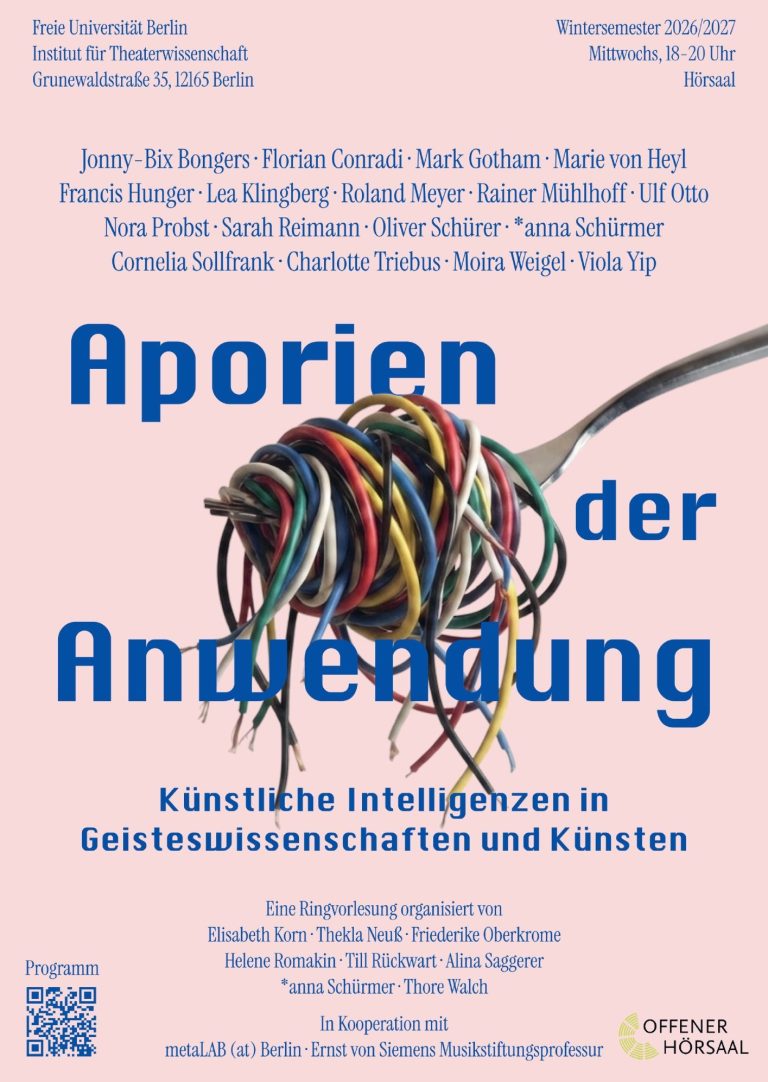
Ringvorlesung
"Aporien der Anwendung"
Jenseits technokapitalistischer Überhöhungen und apokalyptischer Untergangsrhetorik versteht die Ringvorlesung Künstliche Intelligenz weder als Heilsversprechen noch als unausweichliche Bedrohung, sondern begreift sie ausdrücklich eingebettet in die globalen Krisen unserer Zeit. Wir fragen: Wie verändern sich die Praktiken des Forschens, Schreibens, Hörens, Sehens, Komponierens und Gestaltens durch den Einsatz von KI? Welche neuen Formen wissenschaftlicher und künstlerischer Praxis entstehen? Was folgt daraus, dass bislang elementare Kulturtechniken wie etwa das Lesen und Schreiben zunehmend automatisiert werden? Wie können Geisteswissenschaften und Künste diese Entwicklungen kritisch begleiten, sie aktiv gestalten – oder ihnen bewusst widerstehen? Und ist der Einfluss Künstlicher Intelligenz auf Wissenschaft, Kunst und Gesellschaft tatsächlich so alternativlos, wie er vielfach erscheint? Im Mittelpunkt der Vorträge stehen kritische Historisierungen, begriffliche Differenzierungen und künstlerische Experimente. Dabei geraten technologische Infrastrukturen und Machtverhältnisse ebenso in den Blick wie Fragen nach Kreativität, Autorschaft, wissenschaftlicher Praxis und den sozialen und ökologischen Folgen digitaler Technologien.
Moving beyond techno-capitalist hype and apocalyptic rhetoric, this lecture series views artificial intelligence neither as a promise of salvation nor as an inevitable threat, but rather as something explicitly embedded in the global crises of our time. We ask: How are the practices of researching, writing, listening, seeing, composing, and designing being transformed by the use of AI? What new forms of scientific and artistic practice are emerging? What are the implications of the increasing automation of fundamental cultural techniques such as reading and writing? How can the humanities and the arts critically engage with these developments, actively shape them, or consciously resist them? And is the influence of artificial intelligence on science, art, and society truly as inevitable as it often appears? The lectures focus on critical historicization, conceptual distinctions, and artistic experiments. In doing so, they examine technological infrastructures and power dynamics alongside questions of creativity, authorship, scientific practice, and the social and ecological consequences of digital technologies.
Breaking Open the Film Image:
What the Film Scholar Can Learn from Simondon’s Philosophy of Individuation
Vortrag bei den Simondon Oxford Seminars 2026
St John's College, University of Oxford, org. v. Nikolaj Lübecker und Eric White mit Andrea Bardin
The film scholar's creative act consists of inventing regulated interrelations between two sets: the matter of the image and the matter of language, whose virtual differential relation she actualizes with each of her texts. However, in order to capture in syntax what, due to its very medium, constantly threatens to evaporate into duration, she is tempted to freeze and petrify the image, e.g., by fixing it as a simply given representation of reality. Simondon's philosophy of individuation and ontogenesis can help her counter this risky temptation with a mode of thinking that links every image—no matter how self-contained and object-like it may appear—back to the process of its genesis. Using the Romanian documentary film Eight Postcards From Utopia (2024) and a closer examination of the generic characteristics of the advertising image, a method of analysis and historical contextualization is tested that employs Simondon's ideas to understand the individual image along the network of individuating forces contained within it.
Event
Berlin, Februar 2026
1. Vernetzungstreffen
"Marx und Kritische Theorie in der Medienwissenschaft"
Im Februar 2026 versammelten sich am Seminar für Filmwissenschaft an der Freien Universität Berlin Forscher*innen des deutschsprachigen Raums, um sich über Themen, Methoden, Chancen und Probleme auszutauschen, die sich aus dem Zusammendenken von Medien mit Texten aus der kritischen Theorie sowie aus der Marxschen und marxistischen Tradition ergeben. Das Treffen wurde von Patrique Degen, Markus Dietze und Elisabeth Korn organisiert.
In February 2026, researchers from German-speaking countries gathered at the Department of Film Studies at the Freie Universität Berlin to exchange ideas on topics, methods, opportunities, and problems arising at the intersection of Media Studies and Critical Theory as well as Marxist/Marxian theory and analysis. The conference was organized by Patrique Degen, Markus Dietze, and Elisabeth Korn.
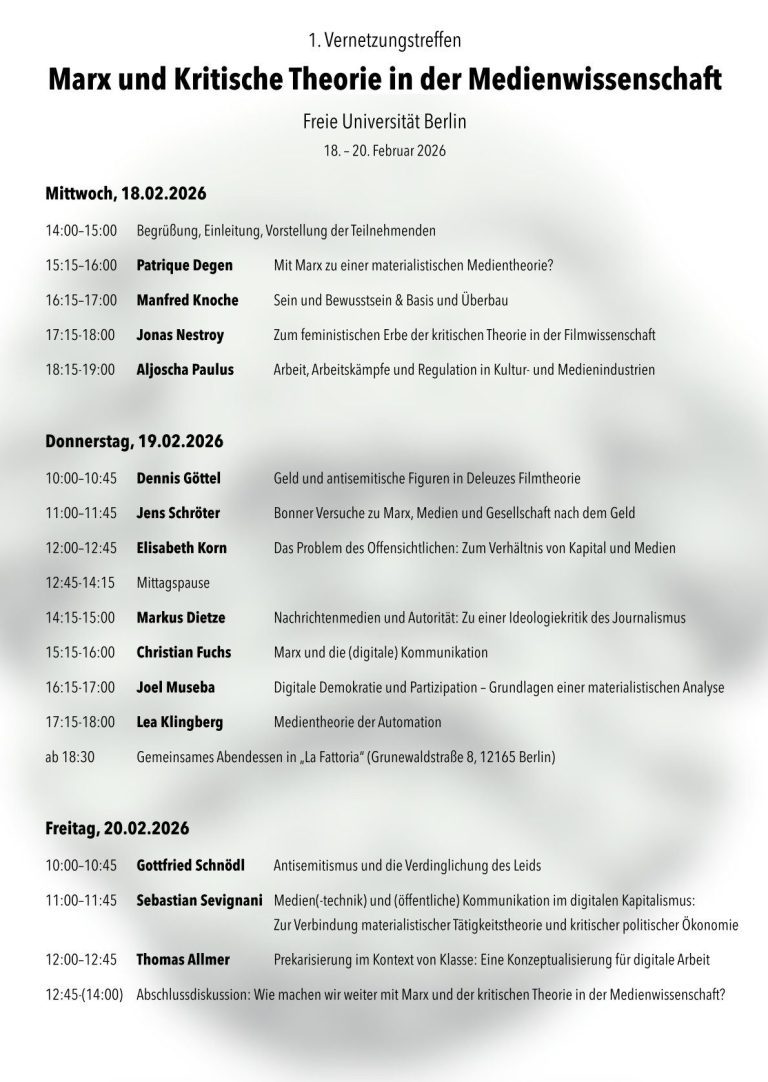
Das Problem des Offensichtlichen:
Zum Verhältnis von Kapital und Medien
Vortrag beim Ersten Vernetzungstreffen Medien und Marx 2026
Freie Universität Berlin, org. v. Patrique Degen, Markus Dietz und Elisabeth Korn
Kapital und Medien stehen in Verhältnis zueinander. Das ist heute keine These und auch keine Mutmaßung mehr, sondern eine Feststellung von so unerschütterlicher Allgemeinheit, dass sie im Grunde offensichtlich erscheint. Um die Kerben und Spuren zu erkennen, die dieses Verhältnis in unserer Lebenswelt hinterlässt, muss man weder eine Definition der kapitalistischen Produktionsweise und der Gesetze ihrer Veränderung parat haben, noch muss man die genaue Funktionsweise einzelner Medientechnologien im Detail wiedergeben können. Beides hilft—das ist überhaupt keine Frage—, aber das philosophische und wahrnehmungsästhetische Problem, vor das uns dieses Verhältnis stellt, beginnt deutlich eher, und zwar mit seiner unverschämten Offensichtlichkeit.
Capital and media are interrelated. This is no longer a thesis or even a conjecture, but a statement of such unshakable generality that it seems fundamentally obvious. To recognize the marks and traces this relationship leaves in our lives, one needs neither a definition of the capitalist mode of production and the laws governing its transformation, nor the ability to describe the precise workings of individual media technologies in detail. Both are helpful—there's no question about that—but the philosophical and perceptual-aesthetic problem this relationship poses begins much earlier: with its blatant obviousness.
Film
Mit Felix Klee
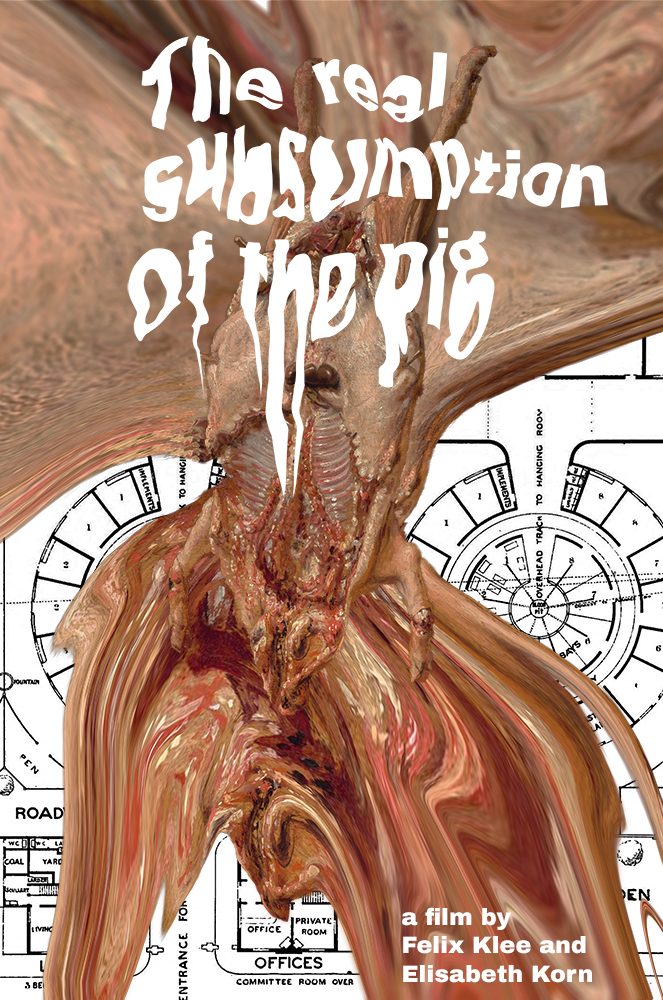
Die reelle Subsumtion des Schweins
The pig was subsumed under capital. This subsumption was expressed in round meat plants, evolving killing machines and refrigerated assembly lines. But under capitalism the pig itself was also changed.
"The real subsumption of the pig" is an essay film piecing together the changing pig's body and its surroundings shaped by capitalism using found footage.
Essay film
in production (rough-cut stage)
ca. 18 minutes
Written and directed by Felix Klee and Elisabeth Korn
Edited by Felix Klee
Event
Berlin 2025/26
Vortragsreihe
"Handhabungen der Filmwissenschaft"
Die Vortragsreihe widmet sich verschiedenen Arbeitsmedien, -weisen und -umgebungen der Filmwissenschaft in Geschichte und Gegenwart; ergänzt um Beiträge, die den Einsatz audiovisueller Medien in verwandten Fächern untersuchen. Die Rede von »Handhabungen der Filmwissenschaft« deutet auf das Händische in der Forschung ebenso wie sie nach Aneignung und (nicht selten prekärer) Inbesitznahme filmischer Artefakte fragt — und sie tangiert den Vorbehalt einer ›Manipulation‹ des Films just durch dessen wissenschaftliche Handhabe. Involviert ist darin immer wieder eine grundsätzliche Kritik an der Verwissenschaftlichung des Films selbst, ergo an seiner Vergegenständlichung. Die Vortragsreihe wurde von Dennis Göttel und Elisabeth Korn organisiert.
The lecture series is dedicated to various working media, methods, and environments of film studies, both historically and in the present day; supplemented by contributions that examine the use of audiovisual media in related disciplines. The phrase "Handling Techniques of Film Studies" points to the manual aspect of research as well as inquiring into the appropriation and (often precarious) possession of cinematic artifacts—and it touches upon the reservation of a "manipulation" of film precisely through its scholarly handling. This repeatedly involves a fundamental critique of the scientification of film itself, and thus of its objectification. The lecture series was organized by Dennis Göttel and Elisabeth Korn.
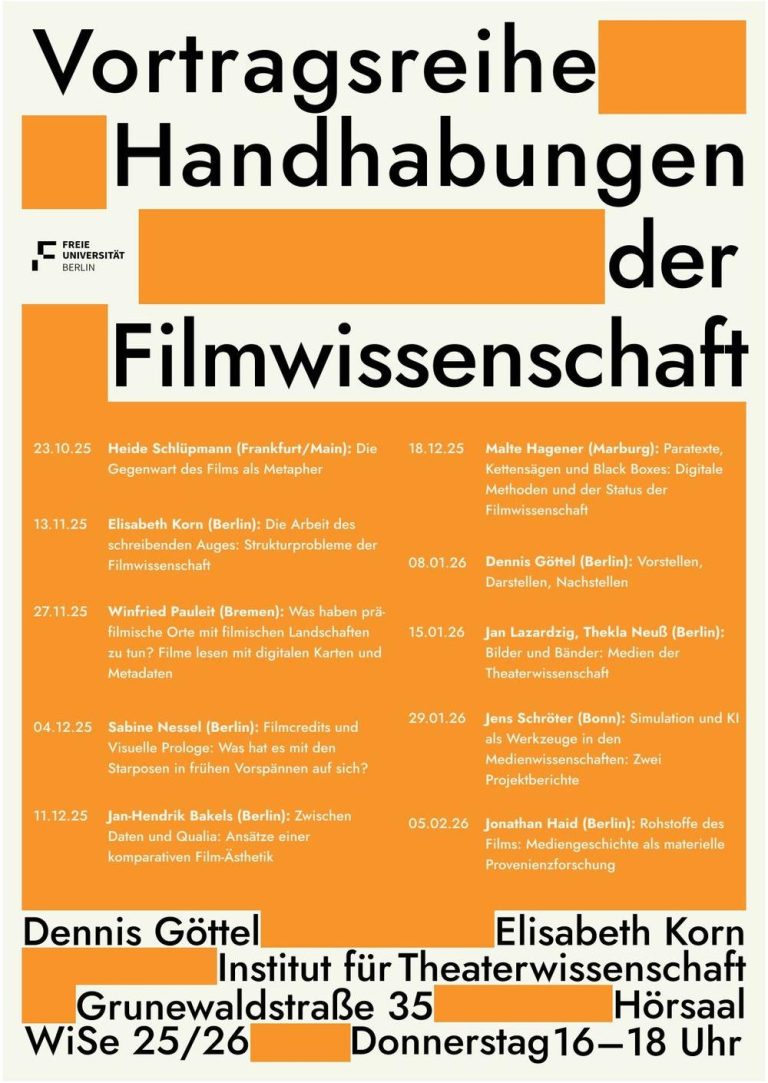
Die Arbeit des schreibenden Auges:
Strukturprobleme der Filmwissenschaft
Vortrag in der Vortragsreihe "Handhabungen der Filmwissenschaft" 2025
Freie Universität Berlin, org. v. Dennis Göttel und Elisabeth Korn
Der Versuch, über Filme zu schreiben, ist die paradoxe Arbeit des schreibenden Auges. Was ich sehe, muss ich verschriftlichen; was ich schreibe, muss ich an das Gesehene zurückbinden. Dies ist eine Arbeit der Unmöglichkeit. Über einen Film zu schreiben, bedeutet immer, ihn zu umschreiben, denn außer ich produziere ein Videoessay, einen DVD-Kommentar oder ein Making-off-Video, besitzt die geschriebene Sprache, derer ich mich bediene, eine andere Materialität als das Bewegtbild, das sie fassen versucht. Diese Unmöglichkeit ist das Strukturproblem, an dem sich die Filmwissenschaftlierin abarbeitet, wenn sie Texte verfasst: auf dem Problemfeld ihrer Disziplin muss sie eine stabile Wechselbeziehung herstellen zwischen zwei Materialitäten, zwei im Grunde inkompatiblem Formen der Sinnschöpfung, deren virtuelles Differentialverhältnis sie aktualisiert in einem einzigen Text.
The attempt to write about films is the paradoxical work of the writing eye. What I see, I must put into words; what I write, I must link back to what I see. This is a work of impossibility. To write about a film always means to rewrite it, because unless I am producing a video essay, a DVD commentary, or a making-of video, the written language I employ possesses a different materiality than the moving image it attempts to capture. This impossibility is the structural problem that the film scholar grapples with when writing texts: within the problem field of her discipline, she must establish a stable interrelation between two materialities, two fundamentally incompatible forms of meaning-making, whose virtual differential relationship she actualizes in a single text.
Publikation
Peer-reviewed
"An Image of Death, an Image of Life, and Nothing In Between"
This article juxtaposes two seminal texts on the ontology of the image published in post-war France: Maurice Blanchot’s ‘Les Deux Versions de l’imaginaire’ (1951) and André Bazin’s ‘Ontologie de l’image photographique’ (1945). Although these essays evince an astonishing similarity — both aim to answer related questions, namely ‘What is the image?’ and ‘What is the film image?’, both draw upon Jean-Paul Sartre and André Malraux, and both identify the image’s being with the power of death —, they arrive at fundamentally different and even opposed conclusions. By negotiating their similarities and differences, this article explores how Blanchot’s approach may be read as a helpful complication of Bazin’s exultant celebration of photography and the film image and, conversely, how Bazin may provide a key for understanding the fundamental antagonism of Blanchot’s bipartite image.
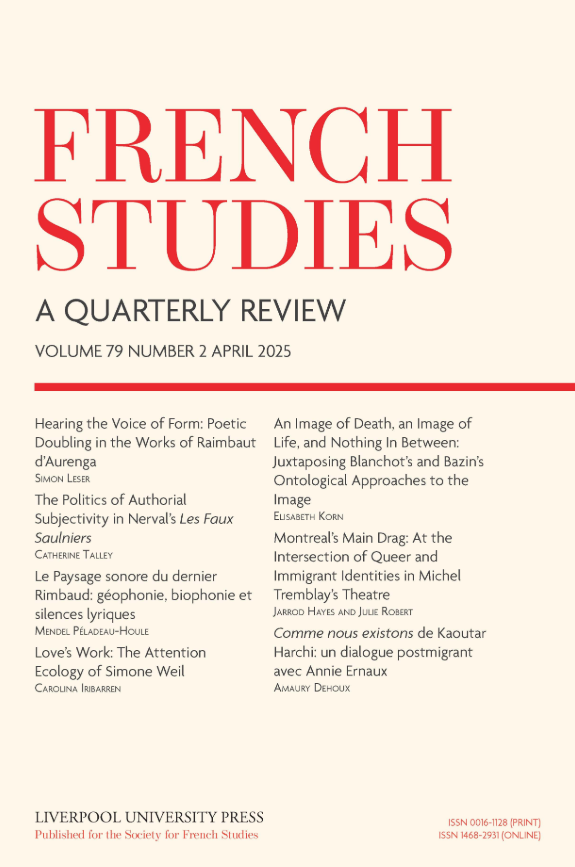
Elisabeth Korn, "An Image of Death, an Image of Life and Nothing In Between: Juxtaposing Blanchot's and Bazin's Ontological Approaches to the Image," French Studies, Jg. 79, H. 2 (2025): S. 231-244.
Linked by the Absence of Links:
Positive Precarity in the Machinic Intersection of Image and Labour
Vortrag auf der Konferenz "Is there a Ubiquity of Precarity? Aesthetic, Media and Political Perspectives on a Contested Phenomenon" 2025
Bauhaus-Universität Weimar, org. v. Sebastian Lederle
This paper engages with the positive aspects of precarity from a media theoretical perspective. Instead of viewing precarity as a purely negative phenomenon, i.e., as an aberration or deviation from an imagined and, more importantly, strategically upheld standard of stable identity and fixed social roles, the shared experience of precariousness is examined as a potential point of departure for a new political aesthetics. It is my contention that we ought to describe as explosively political precisely those media that forge from the loosened ties of precarity a new form of solidarity and that create from the ostensible absence of a common bond of (self)identity a vagabond mode of aesthetic commonality full of desire and disentangled affective forces.
Publikation
Peer-reviewed
"Medientheorie und Politische Ordnung"
Dieser Beitrag schlägt eine Differenzierung zwischen Medientheorien des 20. und 21. Jahrhunderts hinsichtlich ihres Verhältnisses zu politischer Ordnung vor. Erstere verhandeln Medien als Mittel, die sich von einer politischen Ökonomie instrumentalisieren lassen. Letztere reflektieren hingegen eine zunehmende Fraternisierung von Medien, Staat und Kapital, die eine mediale Instrumentalisierung des Politischen nahelegt. Anstatt die Logik einer politischen Ordnung einzig zu reproduzieren, scheinen sich gerade Informations- und Kommunikationstechnologien (IKT) die konstitutiven Subjektivierungspraktiken, Handlungsschemata und Potenzialabwägungen politischer Institutionen einzuverleiben.
This article proposes a distinction between 20th- and 21st-century media theories regarding their relationship to political order. The former treat media as a means that can be instrumentalized by a political economy. The latter, however, reflect an increasing fraternization of media, state, and capital, which suggests a media instrumentalization of the political sphere. Instead of merely reproducing the logic of a political order, information and communication technologies (ICTs) appear to be incorporating the constitutive subjectivation practices, action patterns, and potential assessments of political institutions.
Elisabeth Korn, "Medientheorie und Politische Ordnung," in Christoph Ernst, Katerina Krtilova, Jens Schröter und Andreas Sudmann (Hrsg.): Handbuch Medientheorien im 21. Jahrhundert. Wiesbaden: Springer VS, 2024.
Publikation
Open access
"Paths Not Taken, Dreams Not Dreamt: A Rejoinder to Christian Fuchs on Democracy, the Internet, and Capitalism"
This paper is a rejoinder to Christian Fuchs’ “Democracy, the Internet, and Capitalism,” published in tripleC as a reply to our essay “On a Potential Paradox of Public Service Media” (2024), which was part of tripleC’s special issue “Critical Perspectives on Digital Capitalism: Theories and Praxis”. In this rejoinder, we will critically engage with open questions and unsolved contradictions of three points of discussion: the ideal of deliberative democracy in relation to the Internet, the broadcast model applied to ICTs, and the neutrality of (digital) technology.
Elisabeth Korn und Jens Schröter, "Paths Not Taken, Dreams Not Dreamt: A Rejoinder to Christian Fuchs on Democracy, the Internet, and Capitalism," triple C: Communication, Capitalism & Critique, Jg. 22, H. 2 (2024): S. 550-566.
The Dialectic of Image and Labour:
An Impulse for Rethinking the Culture Industry after 1968
Vortrag auf der German Screen Studies Network-Konferenz "Images at Work" 2023
King's College London, org. v. Laura Lux
In 1944, Theodor W. Adorno and Max Horkheimer famously condemn the amusement offered by the film industry as “the prolongation of work” under late capitalism. As an instrument for the reproduction of labour power, the medium film is said to transpose in its duration of watching the rhythms of Taylor’s stopwatch and Ford’s conveyor belt into the spectator’s stream of consciousness. I want to examine these observations through the lens of a socioeconomic development that Adorno and Horkheimer could not yet foresee and that Beller fails to take into account: the change within late capitalism itself. The demands for self-determination, flexibility and autonomy, uttered by students and workers alike in 1968, are petrified as new imperatives of a system that values creativity and self-promotion over repetitiveness and adaptation. This necessitates the reconceptualization of Adorno and Horkheimer’s seminal phrase: What happens when work becomes the prolongation of what was formerly “mere” amusement?
Publikation
Open access, peer-reviewed
"On a Potential Paradox of a Public Service Internet"
Digital capitalism undermines deliberative democracy. This is the diagnosis arrived at by The Public Service Media and Public Service Internet Manifesto (2021), edited by Christian Fuchs and Klaus Unterberger, and Jürgen Habermas’ A New Structural Transformation of the Public Sphere and Deliberative Politics (2023). They condemn the commercial Internet as a deformation of the public sphere and conclude that it needs to be fundamentally restructured. Interestingly, both texts propose to restructure it after the template of broadcasting media. We seek to challenge this approach from a media-political perspective, arguing that it revives an elapsed version of democracy by rekindling the mass media paradigm to which it was bound. Both texts are implicitly based on the assumption that a technology that emerged in capitalism can be used for different, even contradictory, purposes. But what if the media structure of digital communication, irrespective of who owns or controls it, denies its democratic instrumentalisation?
Elisabeth Korn und Jens Schröter, "On a Potential Paradox of a Public Service Internet," triple C: Communication, Capitalism & Critique, Jg. 22, H. 1 (2024): S. 413-433.